Fifth Seminar in the Series: Keeping Water In The Watershed: Grey To Green: Managing Seven Hills and Five Rivers

A Public Outreach and Resource Seminar Series

Featuring case studies from throughout the US and International locations demonstrating how all water and life is connected, within, on, above and surrounding where we all live ….
And how anyone can take simple steps to make a difference ….

All will be free to attend live but will also be available post event on our education platform.
All begin at 9 AM HST – 10 AM HST (3 PM EST) via Zoom
Every Monday in October and November, December 14 and 21
Please login here: https://us02web.zoom.us/j/82139391920

November 2: Grey To Green: Managing Seven Hills and Five Rivers

  • Host Dendra Best and Jacqueline Diaz-Nieto: Natural Flood and Water Management Coordinator at Sheffield City Council
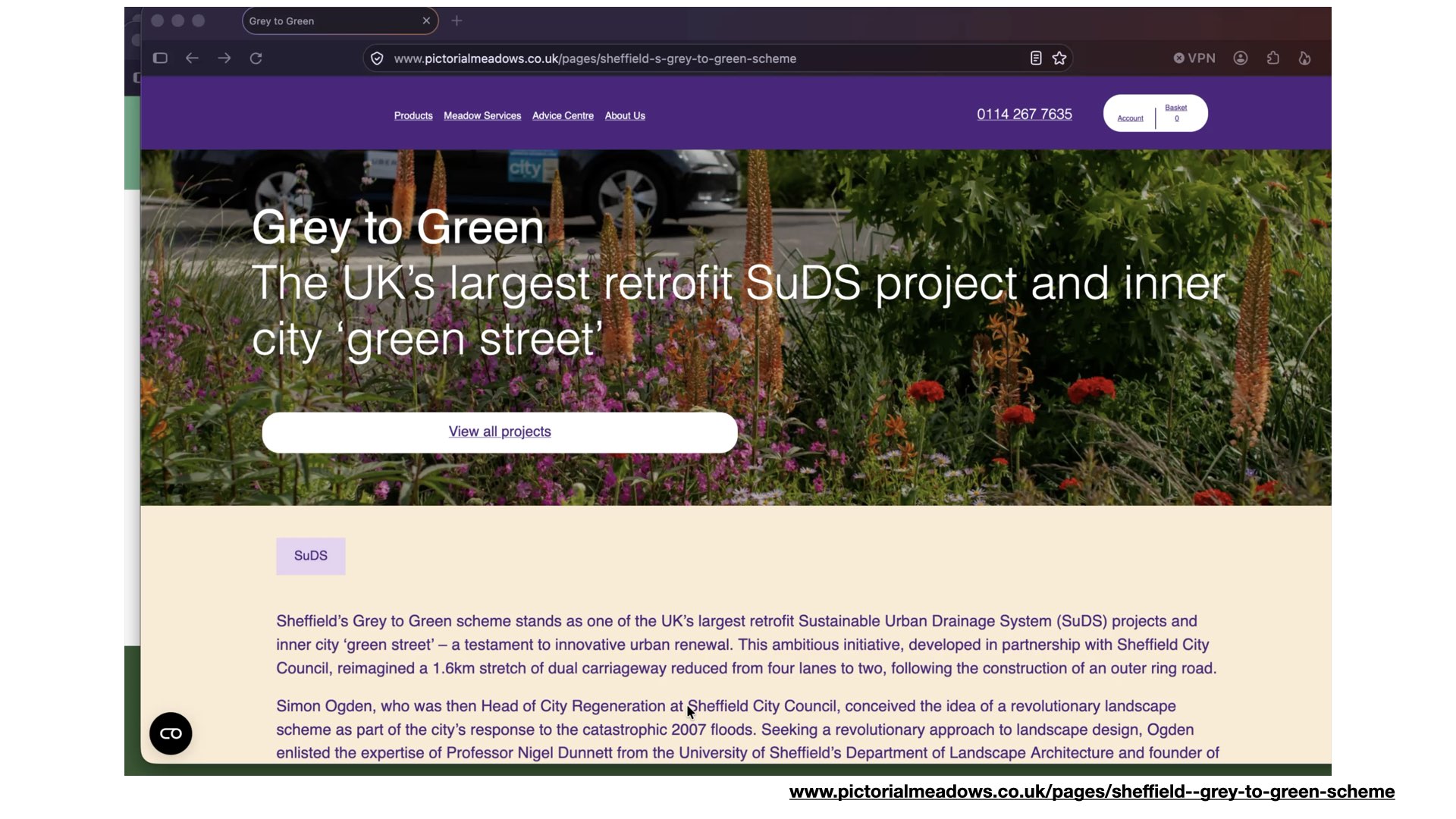
    When catastrophic flooding hit the City of Sheffield in South Yorkshire UK in 2007, the City considered all options: sustainable systems, existing technologies and simple interventions that could have systemic benefits, rather than developing new complex solutions. The central transmission and conveyance systems were facing a massive repair bill. How could they stop this from happening again?

“There is always a place I can take someone’s curiosity and land where they end up enlightened when we’re done. That’s my challenge as an educator. No one is dumb who is curious. The people who don’t ask questions remain clueless throughout their lives.
― Neil deGrasse Tyson

But first a tribute – “Sheffield has lost one of its most quietly remarkable figures. Nigel Dunnett, Professor of Planting Design and Urban Horticulture at the University of Sheffield, who died in April aged just 63. He leaves behind a city that looks visibly different because of his vision.
The man who made Sheffield bloom: [Credit – https://www.sheffieldforum.co.uk/topic/501333-nigel-dunnett-sheffields-landscape-pioneer-who-turned-grey-streets-green-has-died-aged-63/ ]
Most people in Sheffield have walked past his work without knowing his name. The wildflower planting along the ring road, the colour at Park Square roundabout with Park Hill looming behind it, the naturalistic meadows at Sheffield Manor Lodge on the Manor estate — all of it bears his fingerprints.

Dunnett was the driving force behind Grey to Green, Sheffield City Council’s award-winning urban greening project that has been reshaping the city centre since 2014. Described in some quarters as Europe’s largest urban green scheme, it was built with sustainability and flood management in mind as much as beauty. Speaking to the BBC in 2021, Dunnett described its ambition plainly: “The idea was to make Sheffield different, really make it a garden city.”
Fourth Water Reuse Seminar recording available: Keeping Water On The Land: Shelter from The Storm. Storm water management in Miami and South Florida

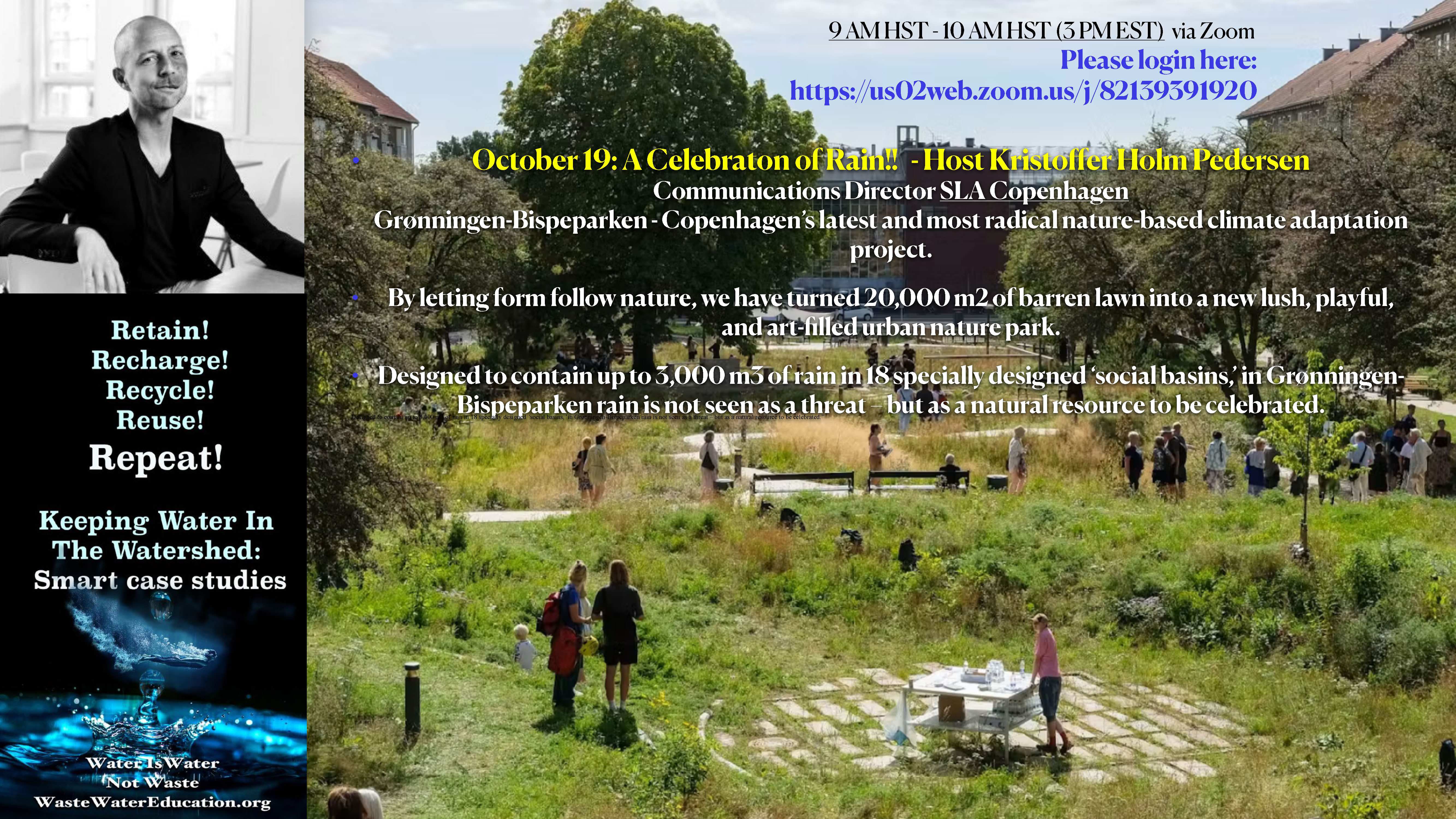
Celebrating the rain…..

Not an event to be feared but an occasion for a community meeting place, full of life, natural systems and an outstanding example of the multiple benefits of nature based systems.

Keeping Water On The Land: Seminar Three

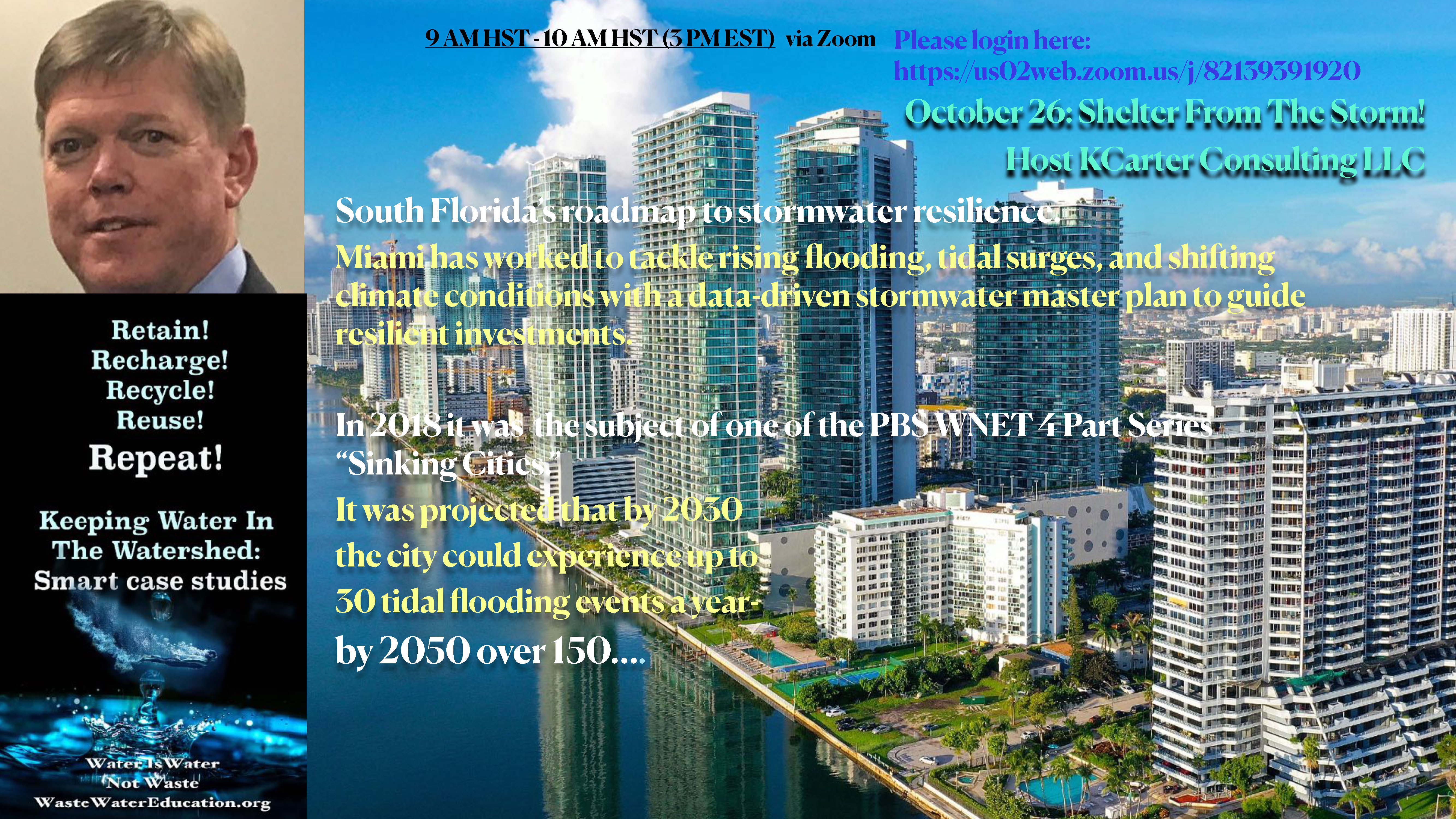
South Florida’s roadmap to stormwater resilience.
Miami has worked to tackle rising flooding, tidal surges, and shifting climate conditions with a data-driven stormwater master plan to guide resilient investments.

In 2018 it was the subject of one of the PBS WNET 4 Part Series “Sinking Cities.”
It was projected that by 2030 the city could experience up to 30 tidal flooding events a year- by 2050 over 150….

Retain! Recharge! Recycle! Reuse! Repeat! Keeping water in the Watershed: Smart Case Studies – Third Seminar

Recording now available at: https://vimeo.com/1237403116?share=copy

And on YouTube at: https://youtu.be/KfpRYWtdnlo

Retain! Recharge! Recycle! Reuse! Repeat! Keeping water in the Watershed: Smart Case Studies – first recording now available

See: https://vimeo.com/showcase/12440659?share=copy&fl=sm&fe=fs

YouTube. https://youtu.be/1lUtW17FCNY

Next Monday: 9 AM HST – 10 AM HST (3 PM EST) via Zoom. 
Please login here: https://us02web.zoom.us/j/82139391920
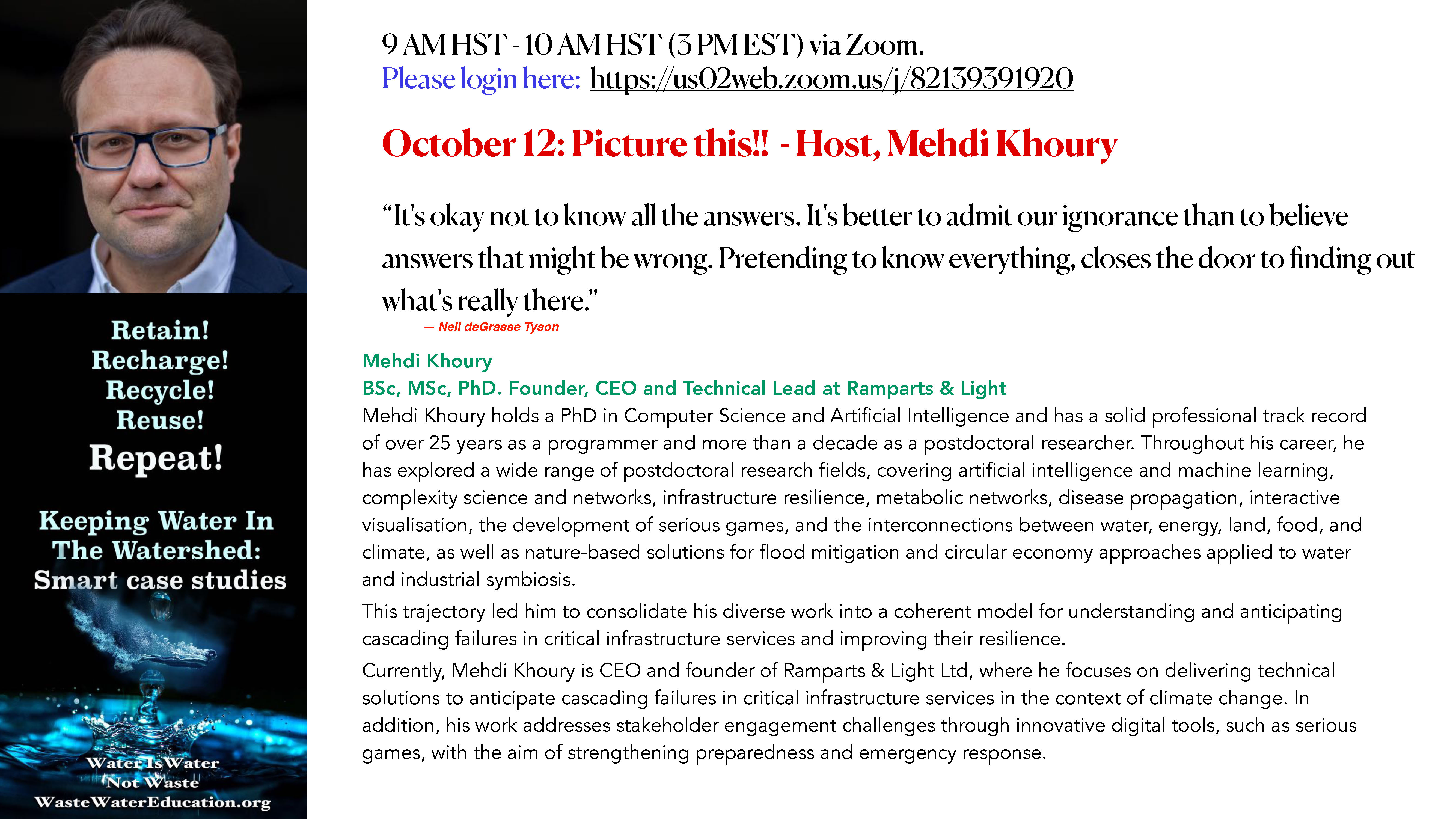
October 12: Picture this!! – Host, Mehdi Khoury

In this seminar, Mehdi Khoury will build on the thoughts detailed in the opening presentation by Phillip Allsop: that the natural world is a complexity of science and inter connected networks.

All human activity impacts how earth, air and water perform and work together – or not.
A basic change in practice, a simple different path taken ,will influence infrastructure resilience, and the interconnections between water, energy, land, food, health and climate.
Interactive visualisation, the development of serious games, will be the topic of this presentation: Nature-based solutions for water resource management, when applied to flood mitigation and a circular economy approach to water and industrial symbiosis.
This presentation invites stakeholder engagement to consider a model for understanding and anticipating cascading failures in critical infrastructure services and improving their resilience.

Retain! Recharge! Recycle! Reuse! Repeat! Keeping water in the Watershed: Smart Case Studies

A Public Outreach and Resource Seminar Series

Featuring case studies from throughout the US and International locations demonstrating how all water and life is connected, within, on, above and surrounding where we all live ….
And how anyone can take simple steps to make a difference ….

All will be free to attend live but will also be available post event on our education platform.
All begin at 9 AM HST – 10 AM HST (3 PM EST) via Zoom
Every Monday in October and November.
Please login here: https://us02web.zoom.us/j/82139391920

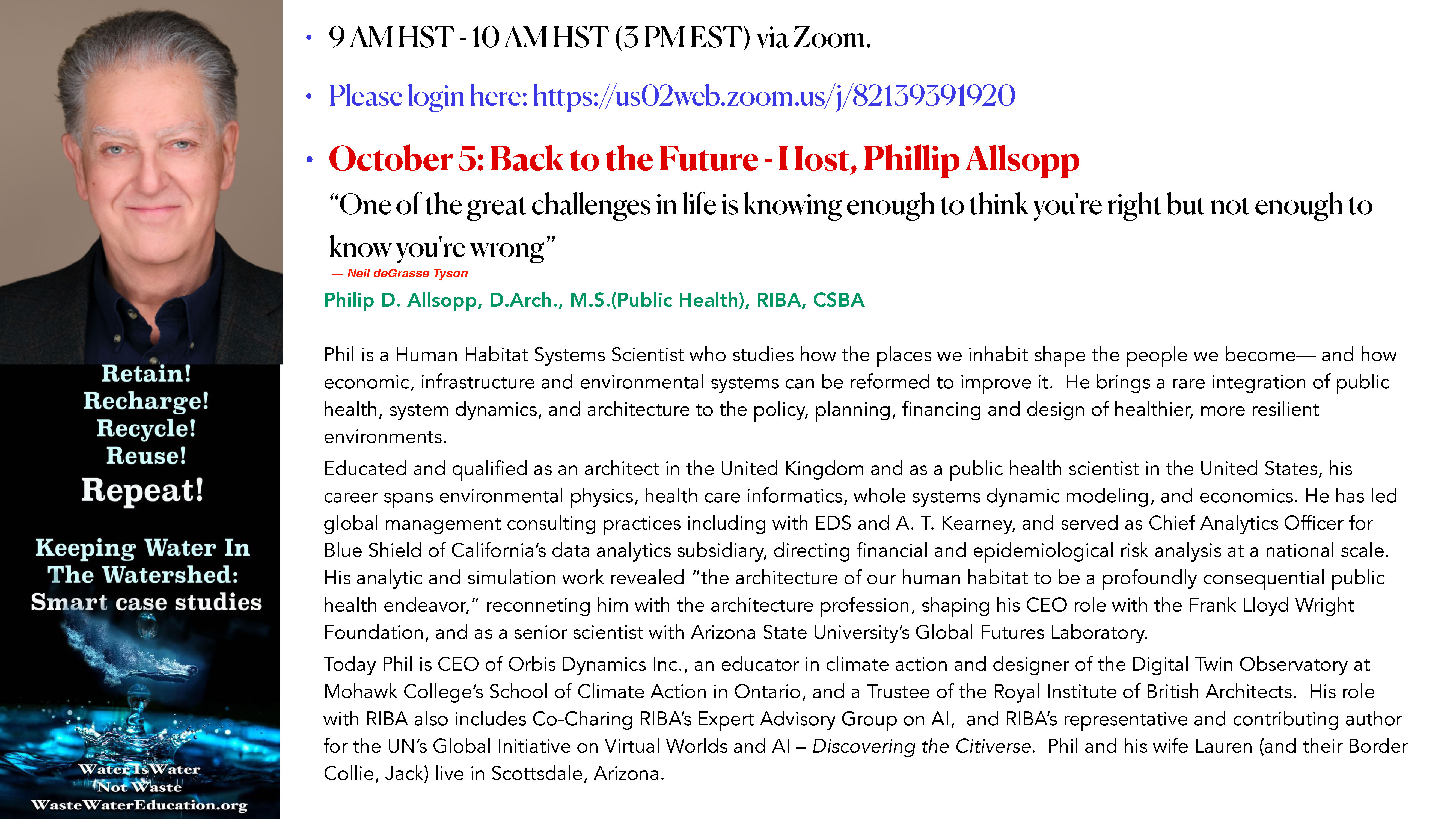
October 5: Back to the Future – Host Phillip Allsopp , will focus on sustainable systems and historical solutions to modern problems emphasizing the importance of looking at existing technologies and simple interventions that could have systemic benefits, rather than developing new complex solutions. Philip will share his approach of emphasizing whole systems thinking and the need for fundamental changes beyond business as usual, drawing parallels to historical solutions and cultural water management knowledge.

New online course available: Nature Based decentralised treatment options

WATER ON THE LAND: Nature Based designs, installs and operation for onsite wastewater systems. Féidhlim Harty: FH Wetland Systems.

REGISTER HERE

Timeline, Initially a live training event but then recorded for perpetual delivery.
Due to unforeseen circumstances the live delivery of this course has been pushed back to later this year. However you may still register for the recorded sessions.
Each session is 90 minutes.

Fee: $155 – currently approved by Ohio and Oregon, other States in review.

Instructor Bio
Féidhlim Harty is an environmental consultant, writer and educator living in Lahinch, Co. Clare. His company, FH Wetland Systems (established in 1996), offers guidance and consultancy on eco-friendly wastewater treatment training and education, and holistic landuse management for catchment protection and regeneration. His books include Septic Tank Options and Alternatives, Permaculture Guide to Reed Beds and Towards Zero Waste.

Course Synopsis
Septic tank effluent and municipal sewage between them comprise one of the largest impacts on water quality in Ireland and throughout the world. Many conventional sewage treatment methods can offer excellent filtration properties, but can be expensive and energy intensive to implement and maintain. Nature based solutions can be used for treatment of domestic septic tank effluent and municipal sewage. These can offer excellent treatment, as well as habitat value, low energy input and carbon sequestration. They include constructed wetlands, reed beds, willow filters, source separation technologies and other similar systems.

Course Outline
More even than individual solutions per se, we will explore ways of thinking and seeing that will help us to respond to our local waterways with action that is both effective and grounded in care and love for the world around us.

Session 1 Introduction to water quality; and an overview of solutions. While the focusing will be on Irish EPA water quality figures, the challenges and solutions are common throughout the world, so the principles will apply to your country, state or local community.
Why water quality is important
The health of our waterways
Factors influencing water quality health
Solutions for sewage, stormwater, agricultural runoff and hydrological damage to waterways “In this session we will learn why water quality is important; gain an understanding of what clean water and polluted waterways look like and examine what pressures exist which impact on water quality. Not to focus on the challenges without exploring solutions, we’ll also look at the ways in which we can address these problems and repair our waterways.” Féidhlim Harty

Session 2 – Exploration of sewage treatment using Nature Based Solutions

• Conventional systems.
Treatment wetlands (designing, building and planting reed beds and constructed wetland systems)
Willows as part of sewage treatment (zero discharge willow systems and incorporating willows into conventional infiltration design)
Source separation technologies and dry toilet systems (overview of the technologies)
“In this session we will examine the options for sanitation and sewage treatment, with an emphasis on nature based solutions which are lower in embedded energy and better for biodiversity. Our exploration will provide participants with an understanding in constructed wetlands, reed beds and willow filters, as well as a suite of source separation technologies which allow for nutrient cycling and closed loop thinking in the arena of sanitation.”

Session 3 – Exploration of stormwater management using Nature Based Solutions
Standard management approach to stormwater
Conventional engineering SUDS systems (Sustained Urban Drainage Systems)
Nature Based Solutions for additional stormwater filtration and habitat enhancement
Designing, building and planting NBS Stormwater Systems
“Session 3 will explore the impacts of stormwater runoff from our urban areas as well as from one-off developments, roads and other areas of hard standing. We will look briefly at the conventional approaches to stormwater management, but will focus particularly on nature based solutions which offer multiple benefits for filtration, biodiversity and beauty on the sites we are working on.”

Session 4 – Farm and catchment scale approaches to water management

• Issues with farm and yard runoff
Solutions using Nature Based Solutions
Catchment management as if water mattered
Rewilding as a tool for waterway repair
“This final session will explore farm and catchment scale solutions for water management. Conventional approaches to farming have multiple challenges stitched into the very fabric of both policy and practice, so alternative methodologies and techniques are already evolving to meet these myriad problems with a whole suite of solutions. We will look at catchment management in a broad sense, as well as farming per se, and explore the role of rewilding as a tool for broad scale landscape repair.”

Timeline, Initially a live training event but then recorded for perpetual delivery.
All Wednesdays at: 2PM EST, 7PM UK, 8AM HST, 11AM PST
September 23
September 30
October 7
October 14
Each session is 90 minutes.

Fee: $155 – currently approved by Ohio, other States in review.

It's all connected! Water IS water, not waste!

WasteWaterEducation-Information

It's all connected! Water IS water, not waste!

Online Education from WasteWater Education 501(c)3

On demand, mobile ready CEU and PDH

Tools For Onsite Property Owners & Wastewater Service Providers

Create your site specific owners maintenance guide

English Septic Blog

All you'll ever want to know about Septic Systems

This Day in Water History

A little bit of water history--one day at a time