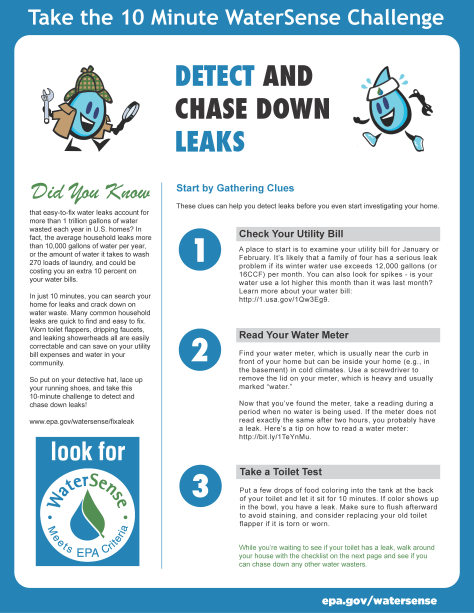
See http://www.currentcast.org/water-conservation-2/checking-your-toilet-for-leaks/


August 2, 1911: Municipal Journal article. Water Waste in Washington, DC. “The matter of detecting and closing underground leaks in the distribution system is one that the water department of Washington has been working on systematically and rather extensively since 1906. At that time the rapid increase in both mean consumption and per capita rates […]
via August 2, 1911: Water Waste in Washington, DC — This Day in Water History
The Board of Directors recently elected Officers for FY2016-17 and appointed new Directors,
See http://www.wastewatereducation.org/boardlist.html
See https://content.govdelivery.com/accounts/USDANIFA/bulletins/1577c06

As temperatures rise this summer, people turn to local beaches and lakes as a fun way to cool off. However, recent toxic algal blooms have hindered this experience for some in places likeFlorida, California, New York, and Vermont. |

July 23, 1800: French patent granted to James Smith, ‘Citizen’ Ciuchet and Denis Monfort for an elaborate filtration device consisting of layers of wool, 2 inches crushed sandstone, 12 inches coarse powdered charcoal pressed into a solid with river sand, and 12 inches of sand or crushed sandstone. “In 1800, the basic Smith-Cuchet-Montfort patent was […]
via July 23, 1800: French Water Filter Patent Issued — This Day in Water History
Swamps, marshes, and other wetland wonderlands… on this CurrentCast.
People once considered wetlands useless, as little more than soggy ground waiting to be drained and put to better use. Now we recognize wetlands as valuable.
Besides being quiet places of safety and serene seclusion for innumerable animal, bird, and plant species, wetlands function for people in amazing ways. They trap and hold raging floodwaters, replenish both groundwater and downstream water bodies, slow soil erosion, and filter out pesky pollutants.
Development projects have devoured millions of acres of wetlands over the past one hundred years, so it’s important that we preserve and protect the wetlands that remain.
CurrentCast is produced in partnership with Cornell’s Atkinson Center for a Sustainable Future. Learn more online at CurrentCast.org.
Ensuring private water wells are safe and tasty… on this CurrentCast.
Approximately 43 million people in the U.S. get their water from private wells. And while most are safe, they should all be tested annually.
Cliff Treyens is with the National Groundwater Association.
Treyens: “Either man-made or naturally-occurring contamination can be a problem. For instance, arsenic and radon occur in the geology in many areas of the country and if it’s above a certain threshold, it could present a health risk.”
Household, agricultural, or industrial contaminants can also filter into the earth and end up in drinking water.
Working with a certified water specialist to test, treat and maintain a well will make sure the water is safe.
CurrentCast is produced in partnership with Cornell’s Atkinson Center for a Sustainable Future. Learn more online at CurrentCast.org.
Let’s toast to more sustainable beer brewing… on this CurrentCast.
Ever been told that if you want to save water, drink ale instead? Unfortunately, there’s not much truth to the joke. A lot of water goes into making beer.
Christenson: “It can vary from about three liters to six liters of water per liter of finished product produced.”
That’s Tod Christenson, Director of the Beverage Industry Environmental Roundtable. He says water is used during the brewing process, as well as for cleaning and cooling.
But there’s change brewing! Christenson says by fixing leaks, recycling water used for cooling, and optimizing their cleaning methods, beer-makers in the Environmental Roundtable have increased their efficiency by fifteen percent in three years. Now I’ll raise a glass to that!
CurrentCast is produced in partnership with Cornell’s Atkinson Center for a Sustainable Future. Learn more online at CurrentCast.org.
It's all connected! Water IS water, not waste!
On demand, mobile ready CEU and PDH
Create your site specific owners maintenance guide
All you'll ever want to know about Septic Systems
A little bit of water history--one day at a time
 WasteWaterEducation-Information
You must be logged in to post a comment.