Session One: Watershed Modeling Tools is now available here.


To view the individual sessions or register for all 8 go to
https://wastewatereducation.org/symposium.html
Session One: Watershed Modeling Tools is now available here.


Feedstock mixture design in anaerobic co-digestion to maximise resource recovery potential
Mike Meng is currently working as resource recovery engineer at Queensland Urban Utilities in Australia leading multiple resource recovery initiatives and R&D projects . Mike has obtained a chemical engineering PhD on anaerobic co-digestion from the University of Queensland and has strong interest in applying expertise to water industry applications for achieving circular economy outcomes.
Mike enjoys wastewater and waste education through knowledge sharing, evident by 5 years of teaching for undergraduate courses “Industrial Wastewater & Solid Waste Management” and “Process Control and Synthesis” at the University of Queensland. An immediate past member on the Australian Water Association Young Water Professional Committee, Mike is passionate about driving a positive change in the committee through participation in mentoring and leading student engagement activities. Mike’s goal is to keep developing engineering expertise and leadership in water and organic waste management and assist Water Utilities in transitioning to full spectrum of resource recovery implementation.
Anaerobic co-digestion (AcoD) is an established technology typically applied to water and agricultural industries to redirect organic wastes away from landfill for beneficial reuse. In AcoD, designing co-digestion mixtures to ensure optimal digester performance and effectively manage co-digestion products is important. In the presentation, Mike will share his PhD research outcomes and practical experience around co-digestion mixture design and operation at one of Australia’s largest sewage treatment plants (STPs).
Currently, in the Australian water industry, there is emerging and strong interest in co-digestion at sewage treatment plants (STPs), which redirects commercial trade wastes away from the landfill for beneficial reuse. AcoD is a biochemical engineering approach that simultaneously treats two or more waste streams in a centralized digestion facility for enhanced energy recovery and enables circular economy outcomes.
Designing co-digestion mixtures for optimised digester performance was a knowledge gap in research as well as in practical application. This means selecting compatible feedstocks at the right volumes with optimal feeding strategies for digesters needs to be understood and incorporated into specific digester operating scenarios.
Co-digestion of complex solid wastes such as fat, oil, grease and food waste with sewage sludge is a step change for many water utilities in Australia and hence requires a series of technical and organizational barriers to be overcome. Developing in-depth understanding of the co-digestion process, its associated downstream impacts, and meeting additional infrastructure requirements for co-digestion are important. In particular, organic waste characterization, co-digestion mixture design, and co-digestion product management are some key areas many water utilities’ waste-to-resources initiatives are currently focusing on. As part of the presentation, Mike will also give an overview of some of the resource recovery initiatives Queensland Urban Utilities are undertaking and how he is using research findings to assist the organisation in the resource recovery space.
You can watch a recording of this event here:

WasteWater Education 501(c)3 came to the close of our FY2019-20 with a healthy balance and increased participation – in both distance learning online/on demand CEU classes and WWETT sponsored public education events! Look for the publication of our Annual Report here shortly.
It is with a heavy heart we acknowledge the demand for our distance learning expertise has come at a sad cost and for the saddest of reasons – Covid19. We are honored to help but wish it wasn’t for this reason.
Since the June WWETT event discussing the innovation happening in Swedish wastewater reuse, we have hosted the following events which you can also view on our YouTube Channel.


WasteWater Education recently renewed the 2 year contract for our long serving Executive Director Dendra Best. Our official mailing address and company contact is still in Michigan but Dendra has now relocated to just outside Hilo, HI.
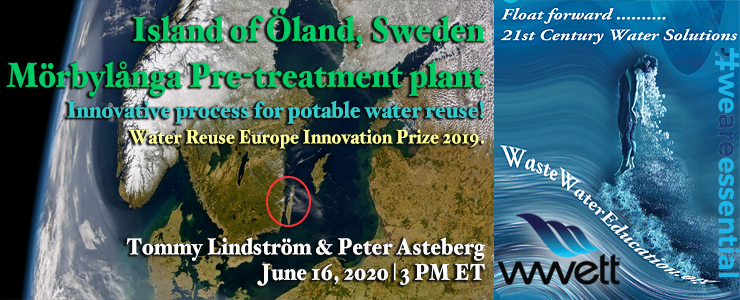
Innovation in potable reuse in Sweden. REGISTER HERE
From 2014 to 2019 Peter Asteberg was the project manager for the planning, design and construction of three new drinking water plants on Öland, a Swedish island in the Baltic Sea with extensive water shortage. In 2016 he was assigned to manage the development of a combined desalination and water reuse plant in Mörbylånga on the southeast coast of Öland. The Mörbylånga Drinking Water Plant, which was partly commissioned in 2019, is the first full-scale facility ever in Sweden for direct potable reuse of water. Therefore, the plant has received both national and international attention.
Co-Presenter is Tommy Lindström, BSc Construction Engineering and Energy. As a former island energy strategist, he has collaborated with islands across Europe and have great knowledge and experience on the island perspective. After being the regional energy coordinator for the county administrative board he is now back in international projects as project manager for the regional energy agency for southeast of Sweden. Working with resilience, sustainable tourism, renewable energy, energy efficiency and smart transports. As a volunteer he supports the Swedish Eco-municipality Association with international collaboration with South America and is also the Energy and Waste management coordinator at Engineers without borders- Sweden.
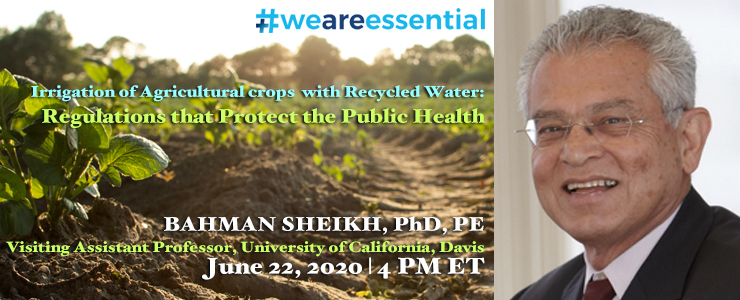
Irrigation of Agricultural crops with Recycled Water: Regulations that Protect the Public Health – REGISTER HERE
Bahman Sheikh has over 30 years of domestic and international experience in research, planning, and design of water resources projects, specializing in water conservation, reclamation, reuse, and recycling. Dr. Sheikh’s career began as a university professor. His academic career was followed by consulting, technical investigations, master planning, and design of water resources facilities. Sheikh’s water recycling experience includes service in both the public and private sectors. For the City of Los Angeles, he developed long-term water reuse goals, planned water recycling projects to the year 2090, and advanced public outreach.
This webinar focuses on the experience gained in the field in California and other regions over the past several decades regarding use of recycled water for irrigation of agricultural crops. Regulations governing use of recycled water for agriculture will be discussed comparing their stringency and effectiveness with special emphasis on microbial risks. Chemical risks from use of recycled water for irrigation will also be discussed summarizing research findings of recent years, particularly with regard to constituents of emerging concerns, also called microconstituents.
The main conclusion of the webinar is that existing regulations are adequately protective of the health and safety of farm workers and consumers of agricultural crops grown with recycled water. The extremely low concentrations of microconstituents detected in recycled water are placed in perspective with calculated numbers of years of exposure necessary to accrue one safe daily dose of each of the constituents of concern.
The main audience for this presentation includes professional engineers, utility managers, farm managers, irrigation experts, and others interested in the safety of agricultural products grown with recycled water irrigation.
It's all connected! Water IS water, not waste!
On demand, mobile ready CEU and PDH
Create your site specific owners maintenance guide
All you'll ever want to know about Septic Systems
A little bit of water history--one day at a time
 WasteWaterEducation-Information

You must be logged in to post a comment.