
On January 26th, ASDWA signed on to the Product Stewardship Institute’s (PSI) letter to the U.S. Food and Drug Administration’s (FDA) Acting Commissioner, urging the FDA “to work with the EPA, the Drug Enforcement Agency, and the White House Office of National Drug Control Policy to: develop clear and consistent guidance to consumers on safe disposal of leftover household medications; end its recommendation that certain medications be disposed by flushing; and clarify that secure medicine take-back programs provide the best disposal method for leftover household medications.” The letter was signed by over 100 environmental and health organizations (including ASDWA and other national water associations), agencies, and a few state legislators to protect water quality from pharmaceutical pollution. In addition, PSI has developed a subsequent letter (not signed by ASDWA) to Congresswoman Louise Slaughter (NY), in support of the Federal Pharmaceutical Stewardship Act to establish producer financed and managed collection programs and provide proper disposal options for unwanted and expired pharmaceuticals. Note, the Act was originally introduced on September 15, 2011, but was not enacted.
All posts by WasteWater Education
Online demonstration of Community Septic System Owners Guide
|
Dirty Little Secrets


With commentary from WasteWater Education 501(c)3 Board Member Catherine Flowers
February 19, 2015 at 2pm ET: Basic Introduction to wastewater treatment and microbiology
Register Here for this complimentary distance learning class.

WasteWater Education welcomes John Jackson as Guest Author

WasteWater Education welcomes Craig H. Lindell as Guest Author
Craig Lindell is a highly respected engineer and innovative thinker who consistently addresses how we need to re-think how we address sanitation issues and development both here in the US and overseas.
 Lindell is a founding principal and former CEO of Aquapoint Inc. Aquapoint is focused on the design, implementation and operating of advanced wastewater treatment, including nutrient removal and reuse, for residential commercial industrial and municipal clients. It has also been an industry leader in designing distributed approaches to infrastructure.
The distributed approach enables communities to design infrastructure to reduce water, energy and nutrient foot prints, align the supply of infrastructure with demand, generate capital and create jobs and often pay for itself.
WasteWater Education 501c3 Has Reached the GuideStar Exchange Gold Participation Level as a Demonstration of Its Commitment to Transparency

WasteWater Education 501(c)3 has Reached the GuideStar Exchange Gold Participation Level as a Demonstration of Its Commitment to Transparency
WasteWater Education 501(c)3, a national water resources education and outreach organization, received the GuideStar Exchange Gold participation level, a leading symbol of transparency and accountability provided by GuideStar USA, Inc., the premier source of nonprofit information.
This level demonstrates WasteWater Education’s deep commitment to nonprofit transparency and accountability.
“We have worked hard to showcase our progress toward our mission, and our long-held belief in being transparent about our work, to our constituents,” said Board Chair Jason Menchhofer. “As a GuideStar Exchange participant, we use their platform to share a wealth of up-to-date information about our work to our supporters and GuideStar’s immense online audience of nonprofits, grantmakers, individual donors, and the media.”
In order to be awarded the GuideStar Exchange logo, WasteWater Education had to fill out every required field of our nonprofit report page on www.guidestar.org for the Gold level of participation.
“I encourage you to check out our profile on GuideStar to see what we’re all about,” added Menchhofer. “We are engaged in exciting initiatives, and we are thrilled to have another platform for communicating our advancement and progress.”
Read our 2014 Charting Impact Statement- PDF LINK here charting_impact
About the GuideStar Exchange
The GuideStar Exchange is an initiative designed to connect nonprofits with current and potential supporters. With millions of people coming to GuideStar to learn more about nonprofit organizations, the GuideStar Exchange allows nonprofits to share a wealth of up-to-date information with GuideStar’s many audiences. Becoming a GuideStar Exchange participant is free of charge. To join, organizations need to update their report pages, completing all required fields for participation. The GuideStar Exchange level logos, acknowledged as symbols of transparency in the nonprofit sector, are displayed on all Exchange participants’ nonprofit reports.
#GivingTuesday #flushedwithsuccess
Every Body Deserves A Decent Throne!
Our primary goal on #GivingTuesday is to help buy 8 Eloos, serving 2 rural communities in Sierra Leone in partnership with DeeperMissions.org

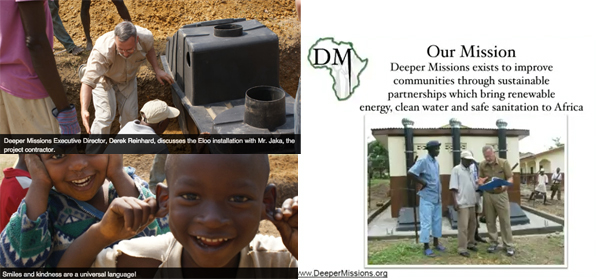 We hear a lot ABOUT what’s happening in Sierra Leone, now come hear from the people themsleves!
Our goal is simple – there’s a place in Northern Sierra Leone, a clinic in Kabala, where they would really like to have a REAL ‘comfort station’ at the beginning, middle and end of their day.
And there’s a school in the NE, at Koidu, where it’s hard to teach basic health when there isn’t a place to do their daily “business’!
We need 8 Eloos ($7,200), $7,300 to ship them, $1,500 to build each stall in the ‘throne room’ – A grand total of $26,500.
So what do you think? How about taking on a piece of this effort so we end this campaign truly #flushedwithsuccess ! You want to do something concrete to make a difference? This is it. Make A DONATION here!
Sometimes the simplest of things can mean the difference of life or death.
When you go to your warm bathroom tonight, and sit down on that nice padded seat, maybe read a book, get comfortable with having a decent throne underneath you …… we hope you’ll remember this #GivingTuesday campaign.
Follow us at : http://twubs.com/flushedwithsuccess


You must be logged in to post a comment.