Tag Archives: sustainability

Keeping Water In The Watershed Seminar 7: From Coastal Science to Climate Resilience: Integrating Nature, Engineering and Innovation to Protect Our Shorelines and Waterways. Sustainable Technology Solutions Global

November 16:  From Coastal Science to Climate Resilience: Integrating Nature, Engineering and Innovation to Protect Our Shorelines and Waterways. Sustainable Technology Solutions Global
All begin at 9 AM HST (2 PM EST) via Zoom

Every Monday in October and November, December  14 and 21

Please login here: https://us02web.zoom.us/j/82139391920

And if you share this link to your social media or elists please remind everyone to double check 9AM HST to their local time zones as not everyone went to Daylight Savings on November 1

Dr. Prince Prakash Jeba Kumar J. is an accomplished marine scientist and coastal ecological engineering specialist with nearly three decades of experience in marine biodiversity conservation, coastal erosion management, estuarine restoration and nature-based solutions.

Formerly a Scientist at India’s National Institute of Ocean Technology (NIOT), he has contributed to major research initiatives involving coastal inlet restoration, sediment dynamics, artificial reefs, mangrove-based shoreline protection and marine environmental impact assessments.

His research includes innovative approaches to stabilising eroding shorelines, restoring river–sea connectivity and integrating ecological engineering with conventional coastal protection infrastructure. He has contributed to more than 75 coastal environmental consultancy assignments and has received several recognitions for his contributions to marine ecological research.

At the webinar, Dr. Prince will share scientific perspectives on nature-based coastal defences, shoreline stabilisation, estuarine restoration and innovative ecological approaches to mitigating storm surge and coastal erosion.

and

P. Ranjan Mishra is an environmental and sustainability leader with over 24 years of international experience in environmental engineering, climate resilience, ecosystem management and sustainable infrastructure across the Middle East and other international markets.

As Chief Executive Officer of Sustainable Technology Solutions (STS), he leads initiatives integrating nature-based solutions, environmental impact assessment, resource management and climate adaptation into practical, commercially viable projects.

His professional background includes senior environmental and sustainability leadership roles with NEOM and Saipem, supporting major infrastructure, coastal and offshore developments. His work encompasses mangrove conservation, environmental risk assessment, ecosystem restoration and sustainable development strategies.

An active researcher and speaker, he has published on the role of mangroves in the UAE’s sustainability transition and presented research on nature-based solutions for climate neutrality.

At the webinar, Ranjan will focus on translating coastal and streamside restoration science into implementable climate-resilience solutions, exploring integrated green–grey infrastructure, stormwater management, ecosystem protection and the practical challenges of scaling nature-based interventions.
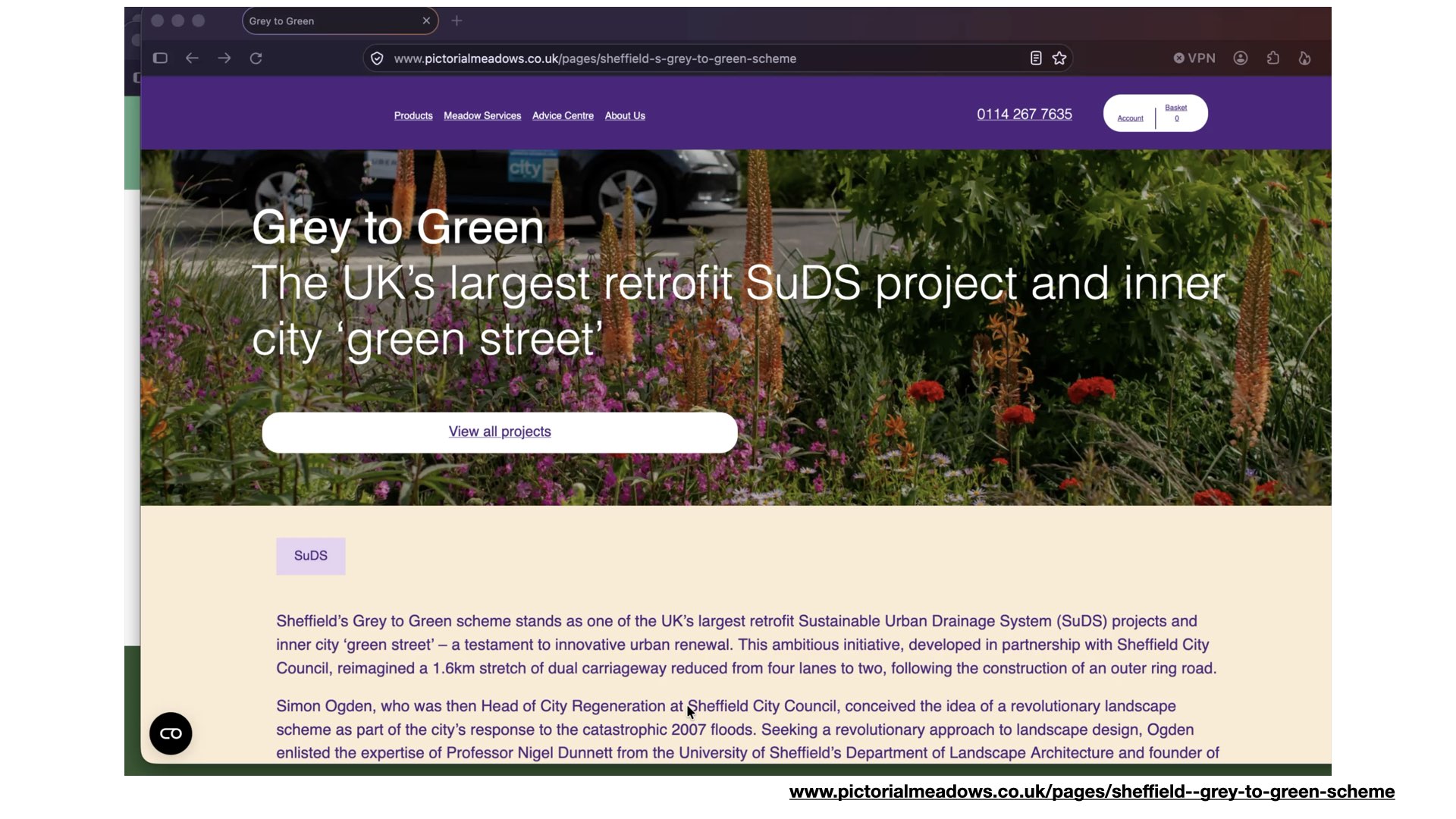
Fifth Seminar in the Series: Keeping Water In The Watershed: Grey To Green: Managing Seven Hills and Five Rivers

A Public Outreach and Resource Seminar Series

Featuring case studies from throughout the US and International locations demonstrating how all water and life is connected, within, on, above and surrounding where we all live ….
And how anyone can take simple steps to make a difference ….

All will be free to attend live but will also be available post event on our education platform.
All begin at 9 AM HST – 10 AM HST (2 PM EST) via Zoom
Every Monday in October and November, December 14 and 21
Please login here: https://us02web.zoom.us/j/82139391920

And if you share this link to your social media or elists please remind everyone to double check 9AM HST to their local time zones as not everyone went to Daylight Savings on November 1 – the Seminars start at 2pm EST

November 2: Grey To Green: Managing Seven Hills and Five Rivers

  • Host Dendra Best and Jacqueline Diaz-Nieto: Natural Flood and Water Management Coordinator at Sheffield City Council
    When catastrophic flooding hit the City of Sheffield in South Yorkshire UK in 2007, the City considered all options: sustainable systems, existing technologies and simple interventions that could have systemic benefits, rather than developing new complex solutions. The central transmission and conveyance systems were facing a massive repair bill. How could they stop this from happening again?

“There is always a place I can take someone’s curiosity and land where they end up enlightened when we’re done. That’s my challenge as an educator. No one is dumb who is curious. The people who don’t ask questions remain clueless throughout their lives.
― Neil deGrasse Tyson

But first a tribute – “Sheffield has lost one of its most quietly remarkable figures. Nigel Dunnett, Professor of Planting Design and Urban Horticulture at the University of Sheffield, who died in April aged just 63. He leaves behind a city that looks visibly different because of his vision.
The man who made Sheffield bloom: [Credit – https://www.sheffieldforum.co.uk/topic/501333-nigel-dunnett-sheffields-landscape-pioneer-who-turned-grey-streets-green-has-died-aged-63/ ]
Most people in Sheffield have walked past his work without knowing his name. The wildflower planting along the ring road, the colour at Park Square roundabout with Park Hill looming behind it, the naturalistic meadows at Sheffield Manor Lodge on the Manor estate — all of it bears his fingerprints.

Dunnett was the driving force behind Grey to Green, Sheffield City Council’s award-winning urban greening project that has been reshaping the city centre since 2014. Described in some quarters as Europe’s largest urban green scheme, it was built with sustainability and flood management in mind as much as beauty. Speaking to the BBC in 2021, Dunnett described its ambition plainly: “The idea was to make Sheffield different, really make it a garden city.”

New online course available: Nature Based decentralised treatment options

WATER ON THE LAND: Nature Based designs, installs and operation for onsite wastewater systems. Féidhlim Harty: FH Wetland Systems.

REGISTER HERE

Timeline, Initially a live training event but then recorded for perpetual delivery.
Due to unforeseen circumstances the live delivery of this course has been pushed back to later this year. However you may still register for the recorded sessions.
Each session is 90 minutes.

Fee: $155 – currently approved by Ohio and Oregon, other States in review.

Instructor Bio
Féidhlim Harty is an environmental consultant, writer and educator living in Lahinch, Co. Clare. His company, FH Wetland Systems (established in 1996), offers guidance and consultancy on eco-friendly wastewater treatment training and education, and holistic landuse management for catchment protection and regeneration. His books include Septic Tank Options and Alternatives, Permaculture Guide to Reed Beds and Towards Zero Waste.

Course Synopsis
Septic tank effluent and municipal sewage between them comprise one of the largest impacts on water quality in Ireland and throughout the world. Many conventional sewage treatment methods can offer excellent filtration properties, but can be expensive and energy intensive to implement and maintain. Nature based solutions can be used for treatment of domestic septic tank effluent and municipal sewage. These can offer excellent treatment, as well as habitat value, low energy input and carbon sequestration. They include constructed wetlands, reed beds, willow filters, source separation technologies and other similar systems.

Course Outline
More even than individual solutions per se, we will explore ways of thinking and seeing that will help us to respond to our local waterways with action that is both effective and grounded in care and love for the world around us.

Session 1 Introduction to water quality; and an overview of solutions. While the focusing will be on Irish EPA water quality figures, the challenges and solutions are common throughout the world, so the principles will apply to your country, state or local community.
Why water quality is important
The health of our waterways
Factors influencing water quality health
Solutions for sewage, stormwater, agricultural runoff and hydrological damage to waterways “In this session we will learn why water quality is important; gain an understanding of what clean water and polluted waterways look like and examine what pressures exist which impact on water quality. Not to focus on the challenges without exploring solutions, we’ll also look at the ways in which we can address these problems and repair our waterways.” Féidhlim Harty

Session 2 – Exploration of sewage treatment using Nature Based Solutions

• Conventional systems.
Treatment wetlands (designing, building and planting reed beds and constructed wetland systems)
Willows as part of sewage treatment (zero discharge willow systems and incorporating willows into conventional infiltration design)
Source separation technologies and dry toilet systems (overview of the technologies)
“In this session we will examine the options for sanitation and sewage treatment, with an emphasis on nature based solutions which are lower in embedded energy and better for biodiversity. Our exploration will provide participants with an understanding in constructed wetlands, reed beds and willow filters, as well as a suite of source separation technologies which allow for nutrient cycling and closed loop thinking in the arena of sanitation.”

Session 3 – Exploration of stormwater management using Nature Based Solutions
Standard management approach to stormwater
Conventional engineering SUDS systems (Sustained Urban Drainage Systems)
Nature Based Solutions for additional stormwater filtration and habitat enhancement
Designing, building and planting NBS Stormwater Systems
“Session 3 will explore the impacts of stormwater runoff from our urban areas as well as from one-off developments, roads and other areas of hard standing. We will look briefly at the conventional approaches to stormwater management, but will focus particularly on nature based solutions which offer multiple benefits for filtration, biodiversity and beauty on the sites we are working on.”

Session 4 – Farm and catchment scale approaches to water management

• Issues with farm and yard runoff
Solutions using Nature Based Solutions
Catchment management as if water mattered
Rewilding as a tool for waterway repair
“This final session will explore farm and catchment scale solutions for water management. Conventional approaches to farming have multiple challenges stitched into the very fabric of both policy and practice, so alternative methodologies and techniques are already evolving to meet these myriad problems with a whole suite of solutions. We will look at catchment management in a broad sense, as well as farming per se, and explore the role of rewilding as a tool for broad scale landscape repair.”

Timeline, Initially a live training event but then recorded for perpetual delivery.
All Wednesdays at: 2PM EST, 7PM UK, 8AM HST, 11AM PST
September 23
September 30
October 7
October 14
Each session is 90 minutes.

Fee: $155 – currently approved by Ohio, other States in review.

From novice to ninja! Beneficial aspects of iron salts and iron rich waterworks sludge.

 
“MulFe Concept – saga from novice to ninja”
If you missed this you can catch it on our YouTube Channel
https://youtu.be/L82CSAHLTJ0

 Dr. Sohan Shrestha

Mechanistic understanding of multiple beneficial aspects of iron-salts & iron-rich waterworks sludge uses in integrated urban wastewater system – Lessons learned from lab-scale, pilot, & field studies
Dr. Sohan Shrestha completed his PhD in 2020 from Advanced Water Management Centre (AWMC), School of Chemical Engineering, The University of Queensland (UQ), Brisbane, Australia. Currently, he works as researcher & water treatment operator for Arris Water Pty Ltd.

Hosted by Board Member Ben Kele

JOIN US via Zoom: 
Monday June 28th – 4-5.30PM PT
(7-8.30PM EST) 
9-10.30 AM TUESDAY June 29th. AEST

There is no fee to attend.
Register here!

There has been growing interest in integrated iron(Fe)-salts or waterworks Fe-rich sludge uses for system-wide operation, aiming to reduce the overall chemical footprint of urban water utilities.

The multiple beneficial uses of iron (either in the form of iron-salt or iron-rich sludge) in sewer system and downstream wastewater treatment plant in an integrated manner have found to achieve sulfide removal in sewers (decreasing sewer odour and corrosion), phosphorus (P) removal during wastewater treatment, hydrogen sulfide (H2S) removal during digester biogas generation, including improving the sludge settleability and dewaterability during wastewater treatment processes.

When adopting such integrated strategy of in-sewer iron-dosing, iron is reused four times during transit through the treatment chain of urban wastewater system thereby substantially reducing chemical usages. 

The project outcomes identified clear opportunities for water and wastewater utilities to collaborate, and share the benefits, providing water/wastewater services in a cost-effective manner albeit with improved environmental sustainability.

The current presentation will primarily shed light on the underlying mechanism behind some key beneficial aspects when implementing iron-dosing in integrated sewer-wastewater treatment plant.