
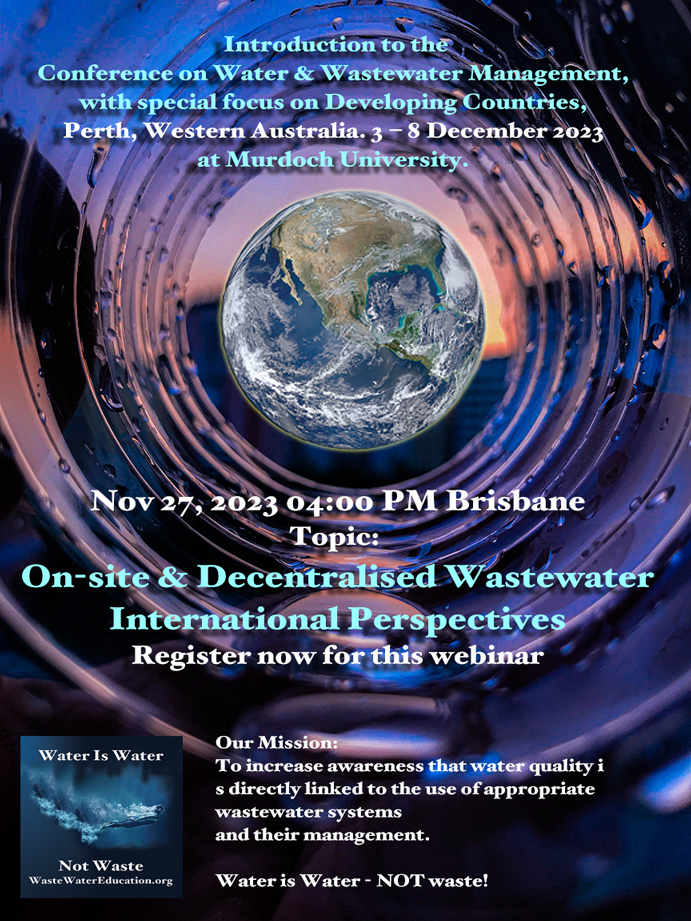
You are invited to a Zoom webinar.
When: Nov 27, 2023 04:00 PM Brisbane
Topic: On-site & Decentralised Wastewater: International Perspectives
Register in advance for this webinar:
https://us02web.zoom.us/webinar/register/WN_uhNSVPwvTxaTiYwsmLBlrg
After registering, you will receive a confirmation email containing information about joining the webinar.
———-
Webinar Speakers
Jerry Hanna (CEO/Chairman @Clearflow Group Inc.)
https://www.linkedin.com/in/jerry-hanna-6a68551a/
Jerry Hanna is the CEO and Founder of Clearflow Group Inc and has 30 year’s experience related to water and water treatment systems and 11 years consulting experience in mining application. Jerry is a Canadian indigenous business owner and is highly experienced in working in rural and remote locations. He has experience in Environmental Impacts, Water Treatment System design and application, Sediment and Erosion Control Construction, Surface Water Management, Water Treatment Systems and has completed projects in Canada and internationally.
Dr. Sara Heger (@Onsite Sewage Treatment Program in the Water Resources Center at the University of Minnesota.)
Dr. Sara Heger is a researcher and instructor in the Onsite Sewage Treatment Program in the Water Resources Center at the University of Minnesota.
Since 1999, she has been providing education and technical assistance to homeowners, small communities, onsite professionals and local units of government regarding onsite wastewater treatment.
Sara coordinates the research program at the UMN and is currently, serving as the principal investigator on projects evaluation wastewater treatment and rest areas and developing training related to the land application of industrial wastewater.
Heger is on the faculty of the Water Resources Science program, teaching Sustainable Waste Management Engineering. She presents at many local and national training events regarding the design, installation and management of septic systems and related research.
Sara is the president of the National Onsite Wastewater Recycling Association (NOWRA). Sara serves on the NSF International Committee on Wastewater Treatment Systems. She is also the chair of the Minnesota State Advisory Committee on Decentralized Systems.
Dr Laurence Gill (@Head of Department, Trinity College Dublin at Trinity College Dublin)
Laurence Gill is a Professor in Environmental Engineering in the School of Engineering, Trinity College Dublin.
His research interests involve studying the fate and transport of both air and water-borne pollutants in the natural and built environment, as well as the development of passive treatment processes.
Much of the work involves extensive field studies which are then used to develop mathematical models to gain further insight into the processes.
Prior to joining at Trinity College in 1999, he spent several years working in the UK water industry on the design of water and wastewater treatment processes for urban populations.
Dr. Gill was a presenter in the 2021 online course – To Perc or NOT to Perc! See https://vimeo.com/625935784?share=copy
Full event at https://vimeo.com/showcase/10709014
Dr. Anish R. Jantria (Associate Professor / Extension Specialist at Texas A&M University System @Biological & Agricultural Engineering Department at Texas A&M University)
linkedin.com/in/anish-jantrania-2748202a
Dr. Anish Jantrania is an Associate Professor/Extension Specialist in the Biological & Agricultural Engineering Department at Texas A&M University.
He is based at the Blackland Research & Extension Center in Temple, Texas.
Dr. Jantrania has over 25 years of experience working in the wastewater industry, in the public and private sectors, with a focus on On-Site Sewage Facilities (OSSF/septic systems), and decentralized wastewater systems used in areas not served by public sewer.
His research and extension interests focus on sustainable infrastructure to ensure the availability of clean water to meet society’s water demands, and to ensure safe sanitation to protect public health and environmental quality.
Before coming to Texas, Anish has worked in Virginia, Massachusetts, and West Virginia, and has studied in West Virginia, South Carolina, Ohio, and India.
His work in Texas will focus on developing a statewide extension education and research program related to surface and groundwater quality protection with specific emphasis on non-point sources, OSSF, and other environmental issues. His work will also focus on education and research needs in water treatment technologies (such as desalination), water capture and multiuse, and conservation technologies that address identified needs in both agricultural and urban sectors.
Ben Kele (Host of Today’s webinar, Director Arris Water, Board Chair WasteWater Education 501(c)3 )
Director at Arris Water, Rockhampton, Australia Director and co-founder of Arris Water a company that specializes in decentralized water treatment and recycling systems. Co-developer and lecturer in the ICEWaRM Post Graduate course the Engineered Water Cycle. Co-developer and co-lecturer in the IWES Decentralised Wastewater Treatment Systems course.
Researcher in Zeolites and other volcanic filter media
Co-developer and co-lecturer in the ICEWaRM Coal Seam Gas Water course



 WasteWaterEducation-Information
You must be logged in to post a comment.