VOTE!!


WasteWater Education 501(c)3 came to the close of our FY2019-20 with a healthy balance and increased participation – in both distance learning online/on demand CEU classes and WWETT sponsored public education events! Look for the publication of our Annual Report here shortly.
It is with a heavy heart we acknowledge the demand for our distance learning expertise has come at a sad cost and for the saddest of reasons – Covid19. We are honored to help but wish it wasn’t for this reason.
Since the June WWETT event discussing the innovation happening in Swedish wastewater reuse, we have hosted the following events which you can also view on our YouTube Channel.


WasteWater Education recently renewed the 2 year contract for our long serving Executive Director Dendra Best. Our official mailing address and company contact is still in Michigan but Dendra has now relocated to just outside Hilo, HI.

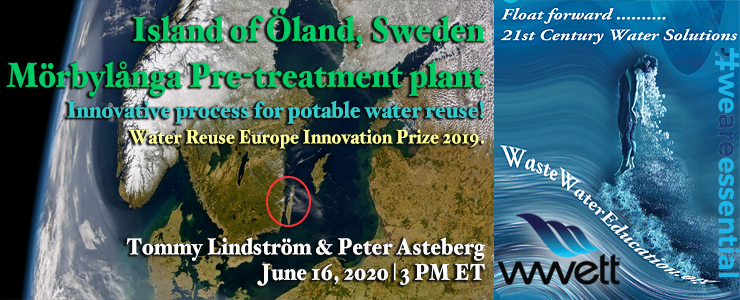
Innovation in potable reuse in Sweden. REGISTER HERE
From 2014 to 2019 Peter Asteberg was the project manager for the planning, design and construction of three new drinking water plants on Öland, a Swedish island in the Baltic Sea with extensive water shortage. In 2016 he was assigned to manage the development of a combined desalination and water reuse plant in Mörbylånga on the southeast coast of Öland. The Mörbylånga Drinking Water Plant, which was partly commissioned in 2019, is the first full-scale facility ever in Sweden for direct potable reuse of water. Therefore, the plant has received both national and international attention.
Co-Presenter is Tommy Lindström, BSc Construction Engineering and Energy. As a former island energy strategist, he has collaborated with islands across Europe and have great knowledge and experience on the island perspective. After being the regional energy coordinator for the county administrative board he is now back in international projects as project manager for the regional energy agency for southeast of Sweden. Working with resilience, sustainable tourism, renewable energy, energy efficiency and smart transports. As a volunteer he supports the Swedish Eco-municipality Association with international collaboration with South America and is also the Energy and Waste management coordinator at Engineers without borders- Sweden.

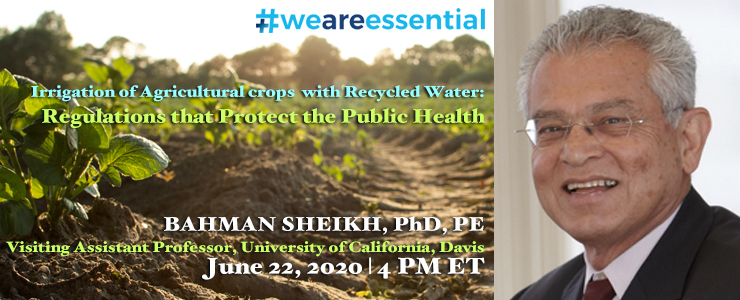
Irrigation of Agricultural crops with Recycled Water: Regulations that Protect the Public Health – REGISTER HERE
Bahman Sheikh has over 30 years of domestic and international experience in research, planning, and design of water resources projects, specializing in water conservation, reclamation, reuse, and recycling. Dr. Sheikh’s career began as a university professor. His academic career was followed by consulting, technical investigations, master planning, and design of water resources facilities. Sheikh’s water recycling experience includes service in both the public and private sectors. For the City of Los Angeles, he developed long-term water reuse goals, planned water recycling projects to the year 2090, and advanced public outreach.
This webinar focuses on the experience gained in the field in California and other regions over the past several decades regarding use of recycled water for irrigation of agricultural crops. Regulations governing use of recycled water for agriculture will be discussed comparing their stringency and effectiveness with special emphasis on microbial risks. Chemical risks from use of recycled water for irrigation will also be discussed summarizing research findings of recent years, particularly with regard to constituents of emerging concerns, also called microconstituents.
The main conclusion of the webinar is that existing regulations are adequately protective of the health and safety of farm workers and consumers of agricultural crops grown with recycled water. The extremely low concentrations of microconstituents detected in recycled water are placed in perspective with calculated numbers of years of exposure necessary to accrue one safe daily dose of each of the constituents of concern.
The main audience for this presentation includes professional engineers, utility managers, farm managers, irrigation experts, and others interested in the safety of agricultural products grown with recycled water irrigation.

June 8, 1909: John L. Leal, George W. Fuller and George A. Johnson present papers at the AWWA annual conference on this day in Milwaukee, Wisconsin, on the chloride of lime treatment system at Boonton Reservoir, New Jersey. Unlike previous presentations on the addition of disinfection chemicals to water, the three papers were received enthusiastically […]
June 8, 1909: Leal and Fuller Papers Presented at AWWA Conference — This Day in Water History
Stay strong. Stay safe. Be well.
WasteWater Education online events are underwritten by the WWETT Show – (Water & Wastewater Equipment, Treatment & Transport) as a public service and thank you to all the hard working professionals affected by the current Covid 19 emergency.
There is no fee to attend but all US based donations to https://www.paypal.com/fundraiser/charity/1727628 will help us continue to provide this service.
For international supporters, please use this link

Small on-site domestic wastewater treatment systems – an Australian perspective .
Monday, June 1, 2020 7:00:00 PM EDT – 8:30:00 PM EDT
(June 2: 8.30 AM Australia)
While much of the developed world has high rates of population connectedness to centralised sewerage and wastewater treatment, the need to deliver effective on-site sanitation via small domestic wastewater treatment systems remains essential for public and environmental health protection.
This webinar will begin with an introduction to decentralised wastewater treatment, followed by a survey of the landscape of standards/regulations governing on-site wastewater systems performance certification internationally, with a focus on the relevant Australian context. It will then provide an overview of an Australian on-site wastewater treatment systems performance accreditation testing facility currently operating in South Australia, including an account of the facility’s operation, a description of some of the treatment systems being tested and their performance, and will give some stories of problems encountered and lessons learnt along the way.
Dr Michael Short, University of South Australia, is an environmental scientist with research expertise in urban water systems (water quality, wastewater treatment and water recycling), environmental microbiology and microbial ecology, sustainability and life cycle assessment. He has a keen interest in how environmental science can be applied to inform the development of better environmental management policy.
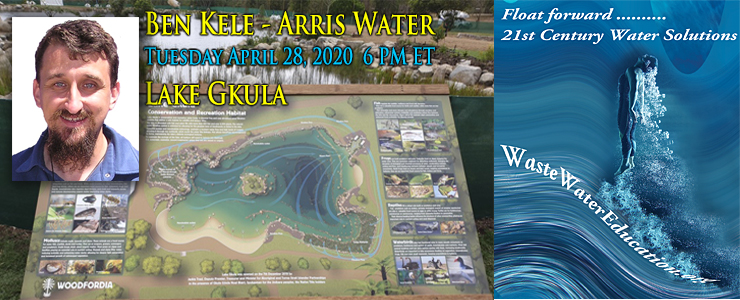
Presented by Ben Kele, Arris Water, and WasteWater Education 501(c)3.
See: https://www.arris.com.au/water/ This is the fourth in a series of events from Australia we are hosting in May.
To view recordings of the previous events click on the images below:

Lake Gkula

This marks the 50th Anniversary of Earth Day – and who could have imagined what kind of world we are experiencing now?
Tuesday April 14 at 2 PM ET – Register HERE
Catherine is also an internationally recognized advocate for the human right to water and sanitation as expressed in the UN Sustainable Development Agenda.
In 2019 she testified before the US House Committee.
She is a Professor of Practice at Duke University.
Image courtesy of Pixabay la Fundación Hugo Zárate

April 5, 1827: Birth of Joseph Lister. He was born in Upton House, Essex, England on April 5, 1827 and died on February 10, 1912. His life covered the entire span of the harshest debates over the germ theory of disease and its general acceptance. Lister completed his medical education including attendance at the Royal […]
via April 5, 1827: Birth of Joseph Lister — This Day in Water History
It's all connected! Water IS water, not waste!
On demand, mobile ready CEU and PDH
Create your site specific owners maintenance guide
All you'll ever want to know about Septic Systems
A little bit of water history--one day at a time
You must be logged in to post a comment.