
Category Archives: Sustainable Water Management
What to Plant | WaterSense | US EPA

What to Plant | WaterSense | US EPA.
The United States has many different climate zones and topographic and geographic features. Each state and even areas within states differ in their ability to support different plant species without the need for supplemental water and fertilizers. The following plant lists will help you identify plants appropriate for your location. When designing your landscape for water-efficiency, be sure to choose plants that are defined as low water use or drought tolerant for your area. These plant species will be able to survive in your climate with minimal, if any, need for supplemental watering. See these simple tips for water-efficient landscaping for more ideas on lowering water use in your yard.
EPA Decentralized MOU Partnership Releases Papers Highlighting the Benefits of Decentralized
EPA Decentralized MOU Partnership Releases Papers Highlighting the Benefits of Decentralized.

EPA Decentralized MOU Partnership Releases Papers Highlighting the Benefits of Decentralized Wastewater Treatment Systems
The U.S. Environmental Protection Agency (EPA) Decentralized Memorandum of Understanding (MOU) Partnership has developed a series of four papers that highlight how decentralized wastewater treatment systems can be sustainable and appropriate options for communities and homeowners. The papers are intended to provide information to the public and to state, local, and industry officials on the benefits and types of decentralized wastewater treatment systems. Decentralized wastewater treatment consists of a variety of onsite approaches for collection, treatment, dispersal, and reuse of wastewater.
The MOU Partnership is an agreement between the EPA and 16 partner organizations including WERF to work collaboratively at the national level to improve decentralized performance and our nation’s public health and water resources. Since 2005, the MOU has reflected the commitment of EPA and its partner organizations to work together to encourage proper management of decentralized systems and increase collaboration among EPA, state and local governments, and decentralized system practitioners and providers. WERF’s extensive research program on decentralized systems as part of the Decentralized Water Resources Collaborative (www.decentralizedwater.org and www.werf.org/decentralized) has helped inform the Partnership’s efforts.
In 2011, the MOU Partnership convened working groups to develop papers around each of four topic areas. MOU partners were selected to participate according to their area of expertise. Each paper focuses on one of four topic areas of decentralized wastewater treatment, demonstrating how decentralized wastewater treatment can be: (1) a sensible solution; (2) cost‐effective and economical; (3) green and sustainable; and (4) protective of the environment, public health, and water quality. For additional information on the EPA Decentralized MOU Partnership and to view copies of the papers, please visit the Decentralized MOU Partnership products page.
Clean Water America Alliance Announces Name Change, New Network | The Solutions Source of the Water & Wastewater Industry
Clean Water America Alliance Announces Name Change, New Network | The Solutions Source of the Water & Wastewater Industry. September 11, 2012
Source: U.S. Water Alliance
The Clean Water America Alliance has changed its name to the U.S. Water Alliance
The Clean Water America Alliance announced a name change to the U.S. Water Alliance, and the formation of a One Water Management network, both reflecting the organization’s core mission.
“We’re changing our name but not our game,” explains Alliance President Ben Grumbles. “The Alliance’s mission—uniting people and policy for ‘one water’ sustainability—remains the same. Our new name is easier to remember and more closely aligned with the integrated ‘one water’ vision we’re working towards in watersheds and communities across the U.S. “
Living Machine System Selected for Wastewater Recycling at New Pennsylvania School; Largest On-Site Wastewater Reuse System Permitted in State of Pennsylvania – US Politics Today

Living Machine Systems, L3C (http://www.livingmachines.com/), the leader in ecological wastewater treatment and reuse technology, today announced that Living Machine® technology is actively treating and recycling all wastewater at Western Wayne County School District’s new Evergreen Elementary School in Wayne County, located in northeastern Pennsylvania. It is the largest on-site wastewater reuse system permitted in the state of Pennsylvania.
Olympic Park | Blogs | Stormwater
Olympic Park | Blogs | Stormwater.
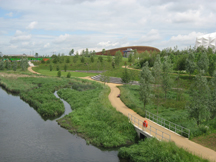
If, like many of us, you’ve been watching the Olympics, you’ve been hearing the stories and profiles of many of the athletes. Here’s a back story you might not be familiar with, although in the last few days you’ve probably seen plenty of photos of the star: Olympic Park.
Four years ago the one-square-mile park, which now houses Olympic Stadium, the Aquatic Center, the Basketball and Water Polo Arenas, and other venues, as well as Olympic Village where the athletes are housed, was a contaminated brownfield site.
With Funding Tight, Cities are Turning to Green Infrastructure by Jim Robbins: Yale Environment 360
With Funding Tight, Cities are Turning to Green Infrastructure by Jim Robbins: Yale Environment 360.
A 2012 studyby American Rivers, ECONorthwest, and other groups examined 479 projects around the country. About a quarter of the projects were more expensive, they concluded, and 31 percent cost the same; more than 44 percent brought the costs down, in some cases substantially. New York City, for example, expects to save $1.5 billion over the next 20 years by using green infrastructure.
Singapore Gardens an Environmental Sustainability Showcase | Water & Wastes Digest magazine – Water and Wastewater Treatment
Opened in spring 2012, Gardens by the Bay features an aquatic ecosystem with sustainable water cycles
Singapore government officials’ vision to become a “city in a garden” came to fruition by redeveloping Marina Bay and boldly allocating prime land and a hefty budget for that purpose. Years of construction later, the Gardens by the Bay officially opened in the spring of 2012, incorporating an environmentally sustainable system that encompasses a lake system in which aeration assists in the ecological process.
 WasteWaterEducation-Information
You must be logged in to post a comment.